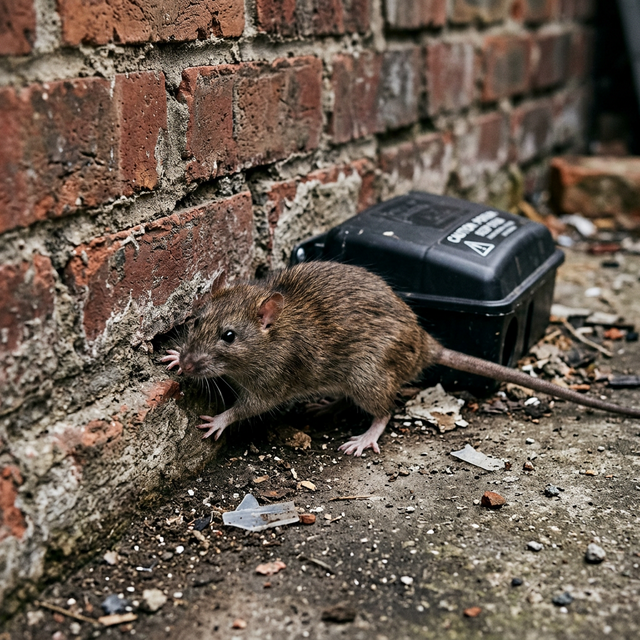
Rodents
Rodentia (Mus musculus, Rattus spp.)
Overview
Rodents are the most common mammalian pests in U.S. homes and businesses. The three primary pest species are the house mouse (Mus musculus), the Norway rat (Rattus norvegicus), and the roof rat (Rattus rattus). Rodents cause billions of dollars in damage annually by gnawing through insulation, wiring (creating fire hazards), and structural materials. They contaminate food with droppings and urine, and can transmit diseases including hantavirus, leptospirosis, and salmonellosis.
Identification
- House mouse: 3–4 inches body, dusty gray, large ears, pointed snout, thin tail
- Norway rat: 7–9 inches body, brown with gray belly, blunt snout, thick tail shorter than body
- Roof rat: 6–8 inches body, black to dark brown, pointed snout, thin tail longer than body
- Both rats and mice have continuously growing incisors that they must gnaw to wear down
- Mice can fit through a hole the size of a dime; rats through a quarter-sized opening
Behavior & Habitat
Rodents are mostly nocturnal and have poor eyesight but excellent senses of smell, hearing, and touch. Mice are curious and will investigate new objects, while rats are neophobic (cautious of new things). A single pair of mice can produce 60+ offspring per year. Rodents follow the same paths repeatedly, leaving greasy rub marks along walls and baseboards. They prefer nesting in dark, undisturbed areas close to food and water.
Signs of Infestation
- Droppings — rod-shaped, dark; mouse droppings are 3–6 mm, rat droppings 12–18 mm
- Gnaw marks on food packages, wood, wires, or plastic
- Scratching or scurrying sounds in walls, ceilings, or attic, especially at night
- Grease marks (rub marks) along walls and baseboards
- Nests made of shredded paper, insulation, or fabric in hidden areas
Prevention Tips
- Seal all gaps and openings larger than 1/4 inch with steel wool and caulk
- Store food (including pet food) in sealed metal or glass containers
- Keep garbage in bins with tight-fitting lids
- Remove bird feeders or use squirrel/rodent-proof models
- Trim vegetation and remove debris from around the foundation
Professional Treatment
Professional rodent control starts with a thorough inspection to identify species, entry points, and nesting areas. Exclusion — sealing all entry points with rodent-proof materials — is the most important step. Snap traps placed along travel routes are the most effective removal method. Bait stations may be used outdoors. We never use loose poison indoors due to secondary poisoning risks. Follow-up visits ensure complete elimination.
Need Rodents Control?
Our experts are ready to help. Get a free, no-obligation quote today.
Get a Free Quote Call (844) 578-0573