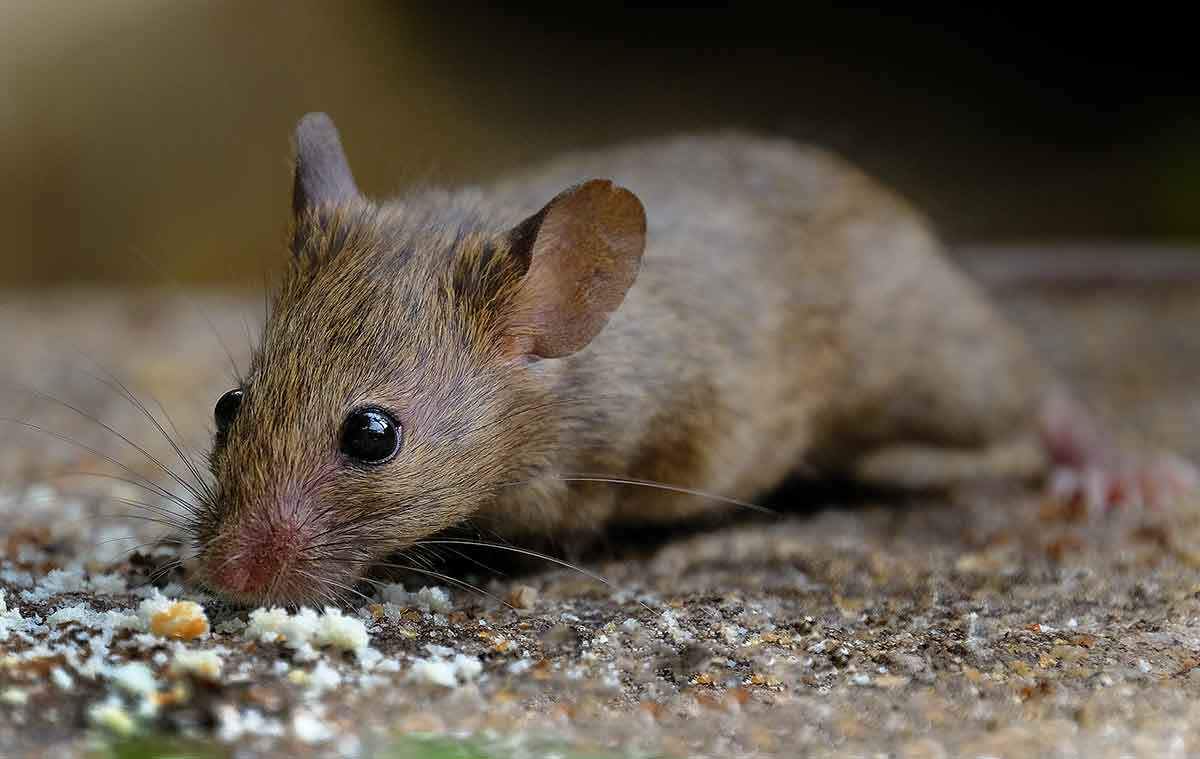
House Mouse (Mus musculus)
The most common rodent pest found in homes and buildings worldwide
Overview
The house mouse (Mus musculus) is a small, highly adaptable rodent that has spread to nearly every continent through its close association with humans. Originally native to Central Asia, the house mouse has been living alongside people for at least 15,000 years, making it one of the most successful commensal mammals on Earth.
House mice are considered one of the most troublesome and economically damaging pests in the United States. They contaminate far more food than they consume, damage structures and wiring through constant gnawing, and can transmit diseases including salmonellosis, leptospirosis, and lymphocytic choriomeningitis (LCM). A single pair of mice can produce over 60 offspring per year under favorable conditions.
Identification
House mice are small, slender rodents that are easily distinguishable from rats by their size and proportions.
Physical Appearance
- Size: Body length 2.5–3.7 inches; tail roughly equal to body length
- Weight: Adults typically 12–30 grams
- Color: Dusty gray to light brown fur on top with a lighter, buff, or ash-gray belly
- Head: Pointed snout with large, rounded ears relative to body size
- Eyes: Small and black
- Tail: Nearly hairless, scaly, and semi-prehensile; roughly the same length as the body
- Feet: Small with four toes on front feet and five on hind feet
Mouse vs. Young Rat
A common confusion is between an adult mouse and a juvenile rat. Key differences: mice have larger ears relative to their head, a more pointed snout, and a thinner tail. Young rats have proportionally smaller ears, blunter snouts, and thicker tails.
Biology & Reproduction
House mice are prolific breeders, which is a major reason why infestations can escalate rapidly.
- Sexual maturity: Reached at 5–7 weeks of age
- Gestation period: 19–21 days
- Litter size: 3–12 pups (average 5–6)
- Litters per year: 5–10 when living indoors with stable food and shelter
- Lifespan: 12–18 months in the wild; up to 2 years indoors
Pups are born blind and hairless. They develop fur within 10 days, open their eyes at 14 days, and are weaned by 3 weeks. Breeding occurs year-round when mice are living indoors.
Behavior & Habits
Activity Patterns
House mice are primarily nocturnal but will forage during the day if food is scarce or if populations are large. Unlike rats, mice are naturally curious and will investigate new objects in their environment, which makes trapping somewhat easier.
Territorial Range
Mice typically stay within 10–30 feet of their nest when foraging. They travel along walls, edges, and established routes, leaving grease marks (rub marks) along frequently used pathways.
Diet
House mice are omnivorous but prefer:
- Cereal grains and seeds
- Sweet foods and chocolate
- Nuts and peanut butter
- Pet food and bird seed
- Insects (occasional opportunistic feeding)
Mice can survive with very little water, obtaining sufficient moisture from their food. They eat approximately 3 grams of food per day and consume food in small, frequent meals at multiple locations.
Physical Abilities
- Can squeeze through openings as small as 1/4 inch (the size of a dime)
- Excellent climbers — can scale rough vertical surfaces
- Can jump up to 12 inches vertically
- Can run up to 8 mph
- Capable swimmers, though they avoid water when possible
Signs of Mouse Infestation
- Droppings: Small, rod-shaped, dark pellets (3–6 mm long) with pointed ends; mice produce 50–80 droppings per day
- Gnaw marks: Small, clean-cut marks on food packaging, wood, wiring, and plastic
- Rub marks: Dark, greasy smears along walls, baseboards, and pipes from repeated travel
- Nests: Made from shredded paper, insulation, fabric, or other soft materials in hidden areas
- Scratching sounds: Light scratching or scurrying inside walls, ceilings, or under floors, especially at night
- Urine odor: A distinct, musty ammonia smell, especially in enclosed spaces
- Tracks: Tiny footprints visible in dusty areas; four toes on front feet, five on rear
Health Risks
House mice pose significant health risks through multiple transmission pathways:
- Salmonellosis: Bacterial infection transmitted through contaminated food and surfaces
- Leptospirosis: Spread through contact with urine-contaminated water or surfaces
- Lymphocytic choriomeningitis (LCM): Viral infection carried in mouse urine, droppings, and saliva
- Hantavirus: While more commonly associated with deer mice, house mice can also carry hantavirus in some regions
- Allergens: Mouse urine, droppings, and dander are significant indoor allergens, particularly affecting children with asthma
Mice contaminate approximately 10 times more food than they consume through droppings, urine, and hair.
Property Damage
- Electrical wiring: Gnawing on wires is a leading cause of unexplained house fires; an estimated 25% of undetermined structure fires may be caused by rodent damage to wiring
- Insulation: Mice shred insulation for nesting material, reducing energy efficiency
- Stored goods: Food packaging, books, documents, and clothing can be destroyed
- Plumbing: Mice can gnaw through plastic pipes, causing leaks
Where Mice Are Found in Homes
Mice are found in homes across every U.S. region and climate. They are commonly treated by PestPro across all service areas including Los Angeles, New York, Houston, Philadelphia, Pittsburgh, and Columbus.
Common Nesting Locations
- Wall voids and cavities
- Behind appliances (stoves, refrigerators, dishwashers)
- Inside cabinets and drawer voids
- Attic insulation
- Basement utility areas
- Garage storage and clutter
- Under sinks near plumbing penetrations
Professional Mouse Control
Effective mouse control requires a systematic approach combining exclusion, trapping, and sanitation. Simply placing poison bait is insufficient and can create secondary problems.
Inspection
A thorough inspection identifies species, population size, entry points, nesting areas, and food sources. Inspectors look for droppings, rub marks, gnaw damage, urine stains (visible under UV light), and active runways.
Exclusion (Sealing Entry Points)
The most critical step. All openings larger than 1/4 inch must be sealed with rodent-proof materials:
- Steel wool packed into gaps and sealed with caulk
- Sheet metal covers over larger openings
- Hardware cloth (1/4-inch mesh) over vents and weep holes
- Door sweeps on exterior and garage doors
- Copper mesh around pipe and wire penetrations
Trapping
Snap traps are the most effective and humane method for eliminating mice indoors. Traps should be placed perpendicular to walls with the trigger end touching the baseboard. Effective bait includes peanut butter, chocolate, or nesting material (cotton or dental floss).
Sanitation
- Store all food in sealed glass or metal containers
- Clean up crumbs and spills immediately
- Remove pet food bowls overnight
- Keep garbage in sealed containers with tight-fitting lids
- Eliminate clutter that provides nesting material
Prevention Tips
- Seal all cracks and gaps around foundations, pipes, and utility lines
- Install door sweeps on all exterior doors
- Store firewood at least 20 feet from the house
- Keep vegetation and shrubs trimmed away from the foundation
- Remove bird feeders or use squirrel/rodent-proof models
- Store pet food in sealed containers, not in bags
- Keep garage doors closed when not in use
- Inspect packages and deliveries for signs of rodent activity before bringing indoors
Frequently Asked Questions
How do mice get into my house?
Mice can squeeze through any gap or hole larger than 1/4 inch. Common entry points include gaps around pipes, utility lines, door frames, dryer vents, weep holes in brick, and cracks in foundations.
I only saw one mouse. Is it a problem?
Yes. Where there is one mouse, there are almost always more. Mice are social and breed rapidly. A single sighting often indicates an established population nearby.
Are mice dangerous?
Yes. Mice contaminate food with droppings and urine, spread diseases, trigger allergies and asthma, and cause structural damage including fire hazards from gnawing on wiring.
Do ultrasonic repellers work on mice?
Research has consistently shown that ultrasonic devices are not effective for long-term mouse control. Mice quickly become habituated to the sound.
Should I use poison bait inside my home?
We recommend against loose poison bait indoors. Poisoned mice may die in inaccessible areas (wall voids, ceilings), causing odor problems. Snap traps are more reliable and allow for carcass removal.
How long does it take to get rid of mice?
With professional exclusion and trapping, most mouse infestations can be resolved within 2–4 weeks. Ongoing exclusion maintenance prevents recurrence.
Need Mouse Control?
Our experts locate entry points, eliminate infestations, and prevent return. Get a free, no-obligation quote today.
Get a Free Quote Call (844) 578-0573